

Could the same rental season create both deductible expenses and lodging-tax obligations, each requiring different records? That distinction is central when reviewing vacation rental tax deductions Colorado owners may be able to claim. Guest taxes aren’t income-tax deductions, and treating them as the same can make tax-season records harder to sort.
If you’re unsure which costs relate to the rental, how personal stays affect expense allocation, or how platform payouts fit in, a clear checklist can help you gather records and prepare questions for a qualified tax professional.
This guide covers expense categories to review, including cleaning, repairs, utilities, platform charges, and management costs, along with records that can support your review. It also explains why rental days and personal use matter, how income-tax deductions differ from taxes collected from guests, and which Colorado and Ouray-area lodging-tax obligations to verify for 2026.
Key Takeaways
- Review mortgage interest, property taxes, insurance, utilities, repairs, and operating supplies with a tax professional. An expense isn’t automatically deductible for every owner.
- Keep rental-day and personal-use records to help determine how shared expenses may need to be allocated.
- For vacation rental tax deductions Colorado owners are reviewing, separate income-tax expenses from lodging and sales taxes collected from guests.
- Identify the property’s jurisdiction, then verify applicable tax types, filing duties, and who is responsible for collection and remittance.
- Reconcile booking-platform statements with bank records, invoices, and guest-tax reports to create a clearer 2026 record set.
Vacation rental tax deductions in Colorado: what owners should separate first
A potentially deductible expense isn’t automatically deductible for every owner. Before sorting receipts, separate costs connected with earning rental income, income-tax reporting, and lodging or sales taxes associated with guest stays. These may appear in the same booking records, but they serve different purposes and follow different rules.
Federal tax treatment can depend on how the property is used, the amount of rental activity, whether the owner also uses it personally, and other circumstances. A checklist is a starting point, not a promise that a particular cost will reduce your tax bill. A tax professional can help apply current rules to your rental activity and records.
An owner expense deduction may reduce taxable rental income if it qualifies. Guest lodging-tax collection is a separate obligation tied to the stay. Keeping those categories apart is a practical first step toward a clearer return and more orderly records.
What does vacation-rental tax deduction mean for an owner?
A tax deduction generally reduces the amount of income subject to tax when an expense qualifies under applicable rules. Rental owners can review costs connected with operating the property and determine whether, and to what extent, they relate to rental activity. The general concept is explained in Understanding Tax Deductions, but a general definition can’t determine how a specific expense applies to your return.
A business expense is not the same as a tax credit, refund, or tax collected from a guest. A credit may reduce tax owed under its own rules; a refund is money returned after an account is reconciled. A guest-facing tax is collected in connection with a stay and may need to be reported or remitted. Don’t treat a guest-tax amount as an operating expense simply because it appears alongside booking revenue. Keep it identifiable in your records for review.
The phrase vacation rental tax deductions Colorado can also lead owners to information about unrelated tax provisions. For example, Colorado HB22-1127 concerned a proposed tenant rent deduction, not deductions for vacation-rental owners, and was postponed indefinitely. It shouldn’t be confused with federal rules that may apply to rental income and expenses.
Is a Colorado lodging tax the same as an income-tax deduction?
No. Lodging taxes generally relate to guest stays and the collection or remittance of tax under applicable state and local requirements. Federal income-tax reporting, by contrast, concerns the owner’s rental income and qualifying expenses. Tracking income-tax expenses doesn’t, by itself, settle lodging-tax responsibilities.
Platforms may handle some tax collection or remittance, but details can vary by platform and jurisdiction. Don’t assume a platform’s handling covers every applicable local requirement. Identify where the property is located, distinguish guest taxes from income-tax records, and verify current Colorado and local guidance, including requirements that apply in the Ouray area. For deductions and reporting, have a qualified tax professional review your circumstances and the records behind each entry.
Colorado vacation rental expenses owners can review for possible deductions
Start an expense review with a complete inventory, not an assumption that every cost qualifies. For vacation rental tax deductions Colorado owners may consider, gather records for the property and tax year, then review how each expense relates to rental activity. Mortgage interest, property taxes, insurance, utilities, repairs, and ordinary operating supplies are common categories to discuss with a qualified tax professional. Whether an item can be deducted, and how much may apply, depends on the facts and current tax rules.
Keep a clear trail from each charge to its purpose: invoices, receipts, statements, and notes that identify the property and date. If a cost covers both personal and rental use, flag it for allocation instead of treating the full amount as a rental expense. A note such as “replacement light bulbs for guest-ready rooms” gives more context than a receipt alone.
Which recurring operating costs should owners gather?
Group recurring costs by category, property, and date. Gather utility bills, insurance statements, cleaning invoices, routine maintenance records, and receipts for supplies used to operate the rental. Include platform charges, management fees, and professional-service invoices for review. These may be relevant expenses, but their treatment depends on the service, rental use, and applicable rules.
Separate owner-paid costs from guest reimbursements and amounts collected for taxes. For example, retain the cleaner’s invoice and the booking record showing any guest-paid cleaning amount. Reconcile the records rather than netting them together without explanation. If management includes marketing, guest communication, maintenance coordination, or housekeeping oversight, keep statements that describe the work and charges. Consistent records can help a tax professional assess each item.
How should owners review repairs, improvements, and depreciation?
Repairs and capital improvements can receive different tax treatment. A repair may address ordinary wear or restore a feature, while an improvement may add value, adapt the property, or extend its useful life. The distinction isn’t always obvious from a receipt, so save the invoice, a description of the work, and relevant before-and-after details for professional review. Don’t assume a large project is immediately deductible or that a smaller job necessarily qualifies as a repair.
Depreciation is another topic to examine carefully. Keep purchase and closing documents, records of eligible property costs, details of later improvements, and the date the rental was placed in service. These records help establish the asset information and basis needed for review. Don’t rely on a rough estimate or apply a calculation without checking current rules. The IRS Guidance on Residential Rental Property covers federal rules for rental homes, including topics relevant to vacation properties. Have a qualified tax professional review current IRS guidance and your circumstances.
Expense purpose, reliable records, and rental-use allocation together help determine what belongs in the tax review. If organizing invoices and operating records takes time away from caring for your property, ALPN Vacations’ local vacation-rental management service includes marketing, guest communication, maintenance coordination, and housekeeping oversight. Those operations can also produce records for your review.
Personal use, rental days, and mixed-use allocation: the key deduction limits
A mountain home can shift between guest-ready rental, owner retreat, and periods when repairs make it unavailable. Those days matter. The amount and type of personal use may affect how expenses are allocated and whether special vacation-home or passive-activity rules apply. Don’t rely on a general rule of thumb: federal definitions, exceptions, and outcomes depend on the facts and tax year.
How can personal stays affect a vacation-rental deduction?
Keep a calendar that distinguishes guest rental nights from nights you, family members, or other permitted users occupy the property. Also note when the home is offered for rent but has no booking, and when it’s unavailable because of maintenance. These categories give a fuller picture than booked nights alone.
Personal use can affect whether expenses are treated as rental-related, personal, or shared. It may also bring special vacation-home limits into play. The right treatment can depend on the owner’s circumstances and how the property was used, so don’t apply a threshold or assume a particular deduction outcome without checking current IRS rules. For the 2026 return, confirm applicable definitions and exceptions with a qualified tax professional.
What records help support mixed-use expense allocation?
Build a consistent record of availability, reservations, owner stays, and closures. Keep invoices and payment evidence tied to the property and reason for each cost. A dated calendar, booking statements, maintenance records, and receipts can help your tax professional understand how the property was used throughout the year.
The comparison below is a recordkeeping guide, not a formula for deciding what’s deductible. Shared costs need to be evaluated under the rules that apply to your circumstances.
| Use pattern | Records to organize | Review focus |
|---|---|---|
| Rental-only | Guest bookings, rental availability, and property-specific invoices | Whether costs relate to rental activity and meet applicable requirements |
| Personal-only | Owner-use dates and receipts for costs incurred during personal use | Keep personal expenses distinct from rental records |
| Mixed-use | Rental nights, personal stays, available-but-unbooked periods, and closures | Ask a tax professional to determine how shared expenses should be allocated |
For example, a utility bill may cover both guest stays and personal visits. Preserve the full bill and use calendar rather than estimating a rental share from memory. Apply the same care to costs that span rental and personal periods. A professional calculation is safer than assuming one allocation method fits every property.
For owners reviewing vacation rental tax deductions Colorado, this use record is a key part of the file. Keep the calendar and supporting documents together, and have a tax professional review vacation-home and passive-activity rules using current federal guidance. Clear dates make the review more grounded and help distinguish personal use from hosting activity.
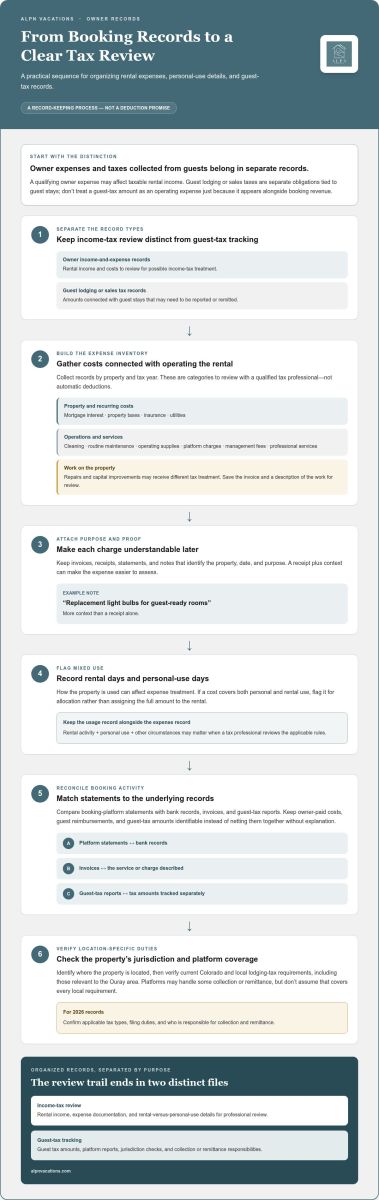
Colorado and Ouray-area vacation-rental tax checks for property owners
Tax review starts with the property’s location, not a booking-platform summary. Its exact jurisdiction can affect lodging-tax and licensing duties, while federal income-tax reporting follows separate rules. Property location can change lodging-tax responsibilities without changing the federal analysis of whether an owner expense qualifies for a deduction. Keep those questions in separate parts of your records.
Use this sequence for each rental, especially if you own properties in different communities:
- Identify the jurisdiction. Record the property’s municipality and county. Don’t rely only on its mailing address or the name used in a listing.
- Name the tax type. Separate federal and Colorado income-tax reporting from state or local sales and lodging taxes connected with guest stays.
- Confirm filing duties. Review current guidance for registration, collection, reporting, or remittance steps that may apply.
- Determine responsibility. Establish what you, your property manager, or a booking platform handles, and retain records showing what was collected or paid.
Which Colorado lodging-tax details should an owner verify?
Start with current Colorado Department of Revenue guidance to identify state tax duties relevant to the rental. Then determine whether the property’s local jurisdiction has separate lodging-tax or licensing requirements. Keep the sources and dates you reviewed with your tax-season file, since rules and administrative details can change. Treat this as a compliance check, separate from calculating federal rental expenses.
Next, review platform statements and transaction details. A platform may collect or remit certain taxes, but that doesn’t establish that every tax or local requirement for every reservation has been handled. Compare platform records with your booking, payout, and tax reports. If a manager or another party handles a step, document the division of responsibility rather than assuming it.
What should Ouray-area owners confirm for their property?
Determine whether the rental is within the City of Ouray, another municipality, or unincorporated Ouray County. Consult current guidance from the applicable local authority, as well as Colorado guidance, for lodging-tax, licensing, and filing details. Verify requirements before each tax season and whenever the property’s location or operating arrangements change.
For local operating context, the Ouray vacation rental management guide covers the setting in which these day-to-day responsibilities arise. Keep local operating records, guest-tax reports, and income-tax expense records organized separately so each can be reviewed for its proper purpose.
Owners reviewing vacation rental tax deductions Colorado should have a qualified tax professional assess current federal and state income-tax treatment, while verifying lodging-tax responsibilities with the relevant authorities. For operational support with marketing, guest communication, maintenance coordination, and housekeeping oversight, explore ALPN’s vacation-rental management services.
A practical Colorado vacation-rental tax deduction checklist for 2026
Set aside time to assemble one clear file for the 2026 tax year. The goal isn’t to decide on your own which costs qualify. It’s to give a qualified tax professional an organized view of rental income, property expenses, personal use, and tax filings so they can apply current rules to your circumstances.
Work through this checklist before your tax review:
- Sort income: Gather booking-platform statements, direct-booking records, payout summaries, and bank deposits. Reconcile differences, including platform adjustments, refunds, or amounts that don’t match deposit totals.
- Organize expenses: Collect receipts and invoices for property costs, supplies, cleaning, repairs, platform charges, management, and professional services. Keep descriptions that explain what each charge covered.
- Document property use: Save the rental calendar, booked nights, personal stays, periods the property was available, and maintenance closures. Keep records together for the same tax year.
- Separate guest taxes: Reconcile guest-tax reports with platform and payment records. Keep amounts collected for taxes distinct from rental income and owner-paid operating costs.
- Check jurisdictional filings: Note the property’s municipality and county, then organize current state and local guidance, registration records, and filed returns relevant to its location.
- Prepare questions: Flag uncertain items, such as mixed-use costs, repairs versus improvements, depreciation, or management expenses, for a tax professional’s review.
What should go into a vacation-rental tax folder?
Use a digital or paper folder labeled with the property and tax year. Include booking income and platform statements alongside bank records, guest-tax reports, receipts, invoices, and property-management statements. Add mortgage-interest and property-tax documents, insurance and utility bills, and records for repairs or improvements. Keep rental calendars and personal-use notes close at hand so each expense can be considered in the context of how the property was used.
Reconcile documents instead of relying on a single source. Compare platform payouts with deposits and retain the related booking statement, then match invoices to payments where possible. Mark missing documents and unresolved differences for follow-up. This creates a useful working file without turning the checklist into an individualized tax determination.
When can local vacation-rental management support the process?
Clear operating records can begin during the season, not just at filing time. Booking information, guest communication, maintenance coordination, and housekeeping oversight can help owners keep an orderly account of activity at the property. ALPN Vacations provides local vacation-rental management in Ouray, including marketing, guest communication, maintenance coordination, and housekeeping oversight. These operational services support rental operations and can help keep the details of hosting organized. The Ouray property management owner guide offers more context on local operating services.
For owners reviewing vacation rental tax deductions Colorado, a well-kept folder is a practical starting point, not a substitute for current tax guidance. Explore ALPN Vacations property management for operational support as you organize the work of hosting.
Make your next tax season feel more orderly
Before the next busy stretch of hosting begins, set a simple routine for saving records as they’re created. Add a brief note to invoices, update the use calendar regularly, and review booking statements during the year. Bring open questions about vacation rental tax deductions Colorado owners may consider to a qualified tax professional, who can review your records against current rules and your circumstances.
ALPN Vacations is locally owned and operated in Ouray, with property management that includes marketing, guest communication, maintenance coordination, and housekeeping oversight. This operational support can help keep rental details moving while you focus on thoughtful ownership.
Explore ALPN Vacations property management to see how local support can fit your rental operations. With clear records and the right guidance, you can approach the season ahead with greater confidence.
Frequently Asked Questions
Can I deduct expenses for a vacation rental in Colorado?
Yes, some ordinary and necessary costs connected with rental activity may be deductible, but not every expense qualifies for every owner. The result depends on the property’s use, why you paid the cost, and applicable federal rules. Guest lodging taxes collected for remittance differ from owner-borne expenses. Keep receipts tied to the property and have a qualified tax professional apply current 2026 guidance to your circumstances.
Is there a special Colorado tax deduction for vacation-rental owners?
Colorado HB22-1127 concerned a proposed deduction for rent paid by tenants, not rental-property expenses, and was postponed indefinitely. Owners should assess possible deductions separately under the rules that apply to their rental activity. Before filing, verify current Colorado law and guidance rather than treating the bill as an owner tax benefit.
Can I deduct vacation-rental expenses if I also use the property personally?
Possibly, but personal stays can affect how expenses are allocated and may bring vacation-home limitations into play. Record guest nights separately from owner or family stays, and note periods when the property was unavailable, such as during repairs. A calendar entry showing a personal visit is more useful than trying to reconstruct dates at tax time. Have a tax professional review your use pattern under current IRS rules rather than applying a universal percentage.
Are Colorado lodging taxes deductible as a vacation-rental expense?
Not necessarily. A lodging-tax amount collected from a guest and held for remittance is different from a tax the owner ultimately pays as an expense. Its accounting and tax treatment can depend on how the charge was collected, reported, and paid. For an Ouray-area rental, compare booking statements with tax filings and payment records so each amount can be traced. Ask a qualified tax professional how specific charges should appear on your return.
What records should I keep for a Colorado vacation-rental tax return?
Keep booking and income statements, bank records, receipts, invoices, management statements, and a calendar showing rental and personal use. Save documents for repairs and improvements, plus evidence of guest taxes collected or remitted. Organize the file by property and tax year; for an Ouray rental, label local tax records with the relevant jurisdiction. Ask your tax professional how long to retain each record, based on current IRS and Colorado guidance.
Can a property manager’s fee be a vacation-rental tax deduction?
A management fee is an expense category to review, not a guaranteed deduction. Its treatment can depend on the services provided, supporting records, rental use, and the owner’s circumstances. Keep the management agreement, invoices, and itemized statements together, and note what services were charged. For example, a statement that separates guest communication from maintenance coordination may give your tax professional useful context. Have the fee reviewed under the rules for the applicable tax year.
Does Airbnb or another booking platform handle Colorado vacation-rental taxes for me?
Not necessarily. A platform’s collection and remittance can vary by jurisdiction, booking, and tax type, so don’t assume it covers every state and local obligation. Compare platform tax reports with your booking records and local filings, and identify amounts or transactions not reflected. For an Ouray property, verify requirements for its exact location and whether owner registration or filing duties remain. Current guidance from the relevant tax authorities can help clarify responsibilities.