
A homeowners policy may not be enough for a Colorado vacation rental. Vacation rental insurance requirements in Colorado can vary by city, county, mountain town, and homeowners association (HOA), and some locations may require specific coverage. Policy exclusions matter too: standard homeowners insurance may not cover short-term rental activity.
It’s easy to assume existing home insurance will protect a property once guests arrive. The right coverage depends on how the home is rented, what the policy excludes, and the risks the property faces, from guest injuries to winter weather damage.
This guide explains when separate or additional insurance may be needed, what can affect its cost, and which homeowners policy exclusions deserve a close read. It also covers protection for guest-caused damage, lost rental income, and mountain conditions that can shape a stay.
Key Takeaways
- Separate or additional coverage may be needed for short-term rentals; local rules and the way a property is used can affect requirements.
- Winter conditions can expose mountain rentals to risks such as frozen pipes, snow-related damage, and guest injuries around icy walkways.
- Read the homeowners policy’s exclusions and terms closely to understand how it treats commercial rental activity, guest-caused damage, and vacant periods.
- Consider how property damage, liability, and interrupted rental income fit into your coverage needs, then explore how vacation rental management may support the property’s operation.
How Much Does Insurance for Vacation Rentals Cost?
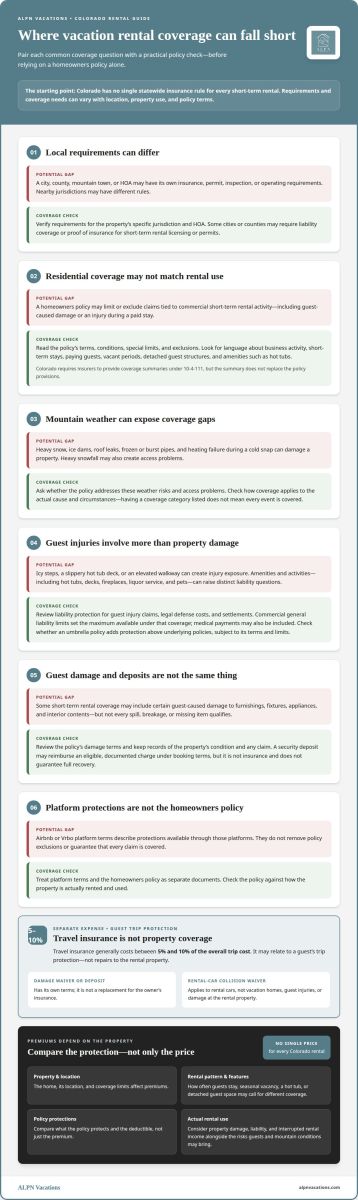
There’s no single price for insuring a Colorado rental property. Premiums depend on the home, its location, coverage limits, and how often it hosts guests. A mountain home with a hot tub, detached guest space, or seasonal vacancy may need different coverage from a regularly occupied condo. Compare the policy’s protections and deductible, not just its premium.
Winter conditions can affect both risk and coverage in ski towns. Heavy snow may damage roofs, while ice dams, roof leaks, and frozen or burst pipes can lead to costly repairs. A heating failure during a cold snap can also put the property at risk. Guests wearing ski boots indoors, leaving doors open in freezing temperatures, or misusing fireplaces and space heaters may contribute to damage. Ask whether the policy addresses these risks and access problems caused by heavy snowfall.
Coverage for accidental damage varies by policy. Some short-term rental coverage may include certain guest-caused damage to furnishings, fixtures, appliances, and interior contents. That doesn’t mean every spill, breakage, or missing item qualifies. A security deposit may reimburse an owner for an eligible, documented charge under the booking terms, but it isn’t insurance and doesn’t guarantee full recovery. Keep records of the property’s condition and any damage claim.
Travel insurance is a separate expense from property coverage. It generally costs between 5% and 10% of the overall trip cost. For guests, this may relate to trip protection, not repairs to the rental property. A damage waiver or deposit arrangement also has its own terms, so don’t treat it as a replacement for the owner’s insurance.
Collision damage waivers apply to rental cars, not vacation homes. Some credit cards may provide a rental-car collision damage waiver when the renter pays with the card and declines the rental company’s waiver. These auto protections don’t cover guest injuries or damage at a vacation rental.
Do You Need Short-Term Rental Insurance in Colorado?
Colorado doesn’t have one statewide insurance rule for every short-term rental. Requirements can vary by city, county, mountain town, and HOA community.
Guest Injury and Liability Coverage
Liability coverage can help address guest injury claims, related legal defense costs, and settlements after an accident on the rental property. Commercial general liability limits set the maximum amount available under that coverage, so the limit matters if an injury claim is substantial. At a mountain rental, icy steps, a slippery hot tub deck, or an elevated walkway can create exposure. Medical payments may also be included in liability protection.
Umbrella and Specialized Liability
Umbrella insurance can add a layer of liability protection above underlying policies, subject to its terms and limits. It may be relevant when guest numbers or activities increase potential exposure. A hot tub, deck, fireplace, or other amenity can create distinct risks; liquor service and pets can raise separate liability questions. Review whether the policy addresses each feature and animal-related incidents rather than assuming one general limit covers every situation.
Insurance Proof for Local Permits
Some Colorado cities or counties may require liability coverage or proof of insurance for short-term rental licensing or permits, but requirements vary by jurisdiction. Rules may also involve inspections, permits, or local operating conditions. Requirements in a ski town may differ from those in a nearby county or HOA community. Treat permit requirements as specific to the property, not as a single statewide standard.
Coverage for Colorado Hosts
Hosts should consider liability protection for guest injuries, legal defense costs, and settlements, alongside property coverage for insured damage. Appropriate limits depend on the home, how guests use it, and risks from features such as steep terrain, icy access, hot tubs, and detached structures. Review whether seasonal vacancy and high-risk amenities affect coverage. These details help match a policy to the rental’s actual use, not just its residential features.
Homeowners policy exclusions for commercial short-term rental activity
Airbnb and Vrbo platform terms are separate from a homeowners insurance policy. Don’t assume platform protections cover every claim or remove exclusions in your policy.
Homeowners Policy Exclusions
A homeowners policy may limit or exclude claims related to commercial short-term rental activity. That distinction matters if a guest’s stay leads to property damage or an injury, because the home’s regular residential use may not reflect its paid rental use.
Read the policy’s terms, conditions, special limits, and exclusions alongside any coverage summary. Colorado requires insurers to provide coverage summaries under 10-4-111, but the summary doesn’t replace the policy provisions. Look for language addressing business activity, short-term stays, and how the insurer treats paying guests.
Common Short-Term Rental Exclusions
Exclusions vary by policy, so there isn’t one standard list for every Colorado rental. Review the sections on guest-caused damage, vacant periods, detached guest structures, and amenities such as hot tubs. These details can reveal gaps between the property’s actual use and the protection described in the homeowners policy.
Also examine how the policy handles weather-related damage. For a mountain property, consider frozen pipes, roof leaks, and access problems after heavy snowfall. A listed coverage category doesn’t automatically mean every cause or circumstance is covered; policy terms and exclusions define the boundaries.
Platform protections and homeowners insurance answer different questions. Airbnb or Vrbo terms describe protections available through their respective platforms, while the homeowners policy sets the insurer’s obligations. Read each document’s limits, conditions, and exclusions separately. A platform’s damage process, for example, doesn’t prove that your insurer covers commercial rental activity.
Colorado policyholders can use the coverage summary to find topics such as contents, personal liability, medical payments, and general exclusions. Then read the corresponding policy provisions for conditions and special limits. This helps identify potential issues before a claim, rather than relying on a summary or booking platform to explain coverage defined by the policy.
Insurance questions for vacation rental owners
Colorado owners should match insurance to the property’s short-term rental use, winter exposures, and income needs. Review coverage for rental activity, damage, vacant periods, and weather. If damage occurs, document it and report the claim according to the policy’s process.
Start with how the home is used. Ask the insurer whether coverage applies to short-term rental activity, direct bookings, guest-caused damage, vacant periods, and weather-related damage. A property rented directly to guests may present different details from one booked through a platform, so describe how stays are arranged.
Property coverage may apply to insured events such as fire, storm, hail, water damage, vandalism, and certain guest-caused damage. Some policies may also cover damage to furnishings, fixtures, appliances, and interior contents. A guest-damaged appliance and a burst pipe, for example, are different causes of loss; policy terms determine how each is handled.
For a Colorado mountain rental, consider ice dams, roof leaks, frozen or burst pipes, power outages, heating failure, and access problems after heavy snowfall. These conditions can lead to repairs that prevent the home from hosting guests. Coverage for the building and its contents doesn’t necessarily replace rental income lost during a closure.
Loss-of-income protection may help offset revenue gaps when wildfire, freeze damage, water damage, severe storms, major repairs, or guest-caused damage temporarily make a property uninhabitable. Consider whether the policy’s covered events and terms match the disruptions most relevant to the rental.
If a loss happens, photograph the damage, keep relevant receipts, and record when the property became unusable. Report the incident through the insurer’s claims process, and retain communications and repair records. A clear timeline can connect the event, the damage, and any rental interruption.
For owners balancing guest stays with property care, explore vacation rental management services as a practical part of operating a Colorado rental.
ALPN Vacations: Vacation Rental Management Services
ALPN Vacations offers Vacation Rental Management Services for owners seeking support with the ongoing work of operating a short-term rental. Management and insurance serve different purposes: management covers rental operations, while the insurance policy defines covered losses, limits, and exclusions. Keep these decisions distinct, and make sure coverage reflects how the property is used.
Travelers can choose from a variety of exceptional properties, such as scenic mountain chalets, amphitheater retreats, and downtown luxury penthouses. Each offers a different way to experience Southwest Colorado, from natural mountain surroundings to a convenient stay in Ouray. For owners, professional management support can be a natural consideration alongside the responsibilities of hosting.
Contact ALPN Vacations to discuss Vacation Rental Management Services for your property.
Make coverage part of your hosting plan
A sound plan for vacation rental insurance requirements in Colorado starts with treating coverage as part of the property’s operating decisions. Rental patterns can change, amenities can be added, and a home may sit vacant between guest stays. Keep your insurer informed when the property’s use changes, and revisit the policy as those decisions evolve. A thoughtful review can help clarify insurance’s role before the next booking arrives.
Hosting also involves decisions beyond the policy itself, from preparing the home to coordinating guest stays. ALPN Vacations offers Vacation Rental Management Services for owners who want support with rental operations. If questions about managing a Colorado rental are part of your next step, contact ALPN Vacations with your questions. You can move forward with greater clarity, one well-considered decision at a time.
Frequently Asked Questions
Does Colorado require vacation rental owners to carry specific insurance?
Vacation rental insurance requirements in Colorado vary by local jurisdiction and property community; there isn’t one statewide insurance rule for every rental. Cities, counties, mountain towns, and homeowners associations can set different licensing, permit, or liability coverage conditions. For example, one community’s permit process may require insurance documentation while another focuses on different operating rules. The property’s location helps determine which requirements apply.
Does homeowners insurance cover vacation rentals in Colorado?
A homeowners policy may not cover claims related to paid short-term stays. The policy language controls, so a home insured for ordinary residential use may have a coverage gap when guests pay to stay there. Read exclusions and conditions for business or rental activity, then consider how they apply to the actual booking arrangement. Direct reservations and platform bookings both involve short-term rental use.
What liability limits are recommended for Colorado vacation rental insurance?
There isn’t one liability limit that fits every Colorado rental. Start by considering the property’s guest capacity, location, amenities, and potential injury risks, then assess whether the limit matches those exposures. A ski-town home with a hot tub or elevated deck presents different considerations from a simpler property. Umbrella coverage may also be part of a discussion about additional protection.
How much does vacation rental insurance cost in Colorado?
Insurance costs depend on the property and the protection selected. Factors include the rental’s location, use, liability limits, amenities, seasonal vacancy, and exposure to winter weather. A home with detached guest space or a hot tub may need different coverage from a smaller rental without those features. Compare coverage and deductibles, not just premiums.
What insurance rules apply to vacation rentals in Denver, Boulder, Breckenridge, and other Colorado towns?
For vacation rental insurance requirements in Colorado, local jurisdiction and community rules matter. Denver, Boulder, Breckenridge, and Ouray may have different licensing, permit, inspection, or liability conditions. HOA or condo rules can add rental restrictions, guest requirements, occupancy limits, or amenity-use policies. A property’s location determines which local requirements apply, so even nearby homes can face different operating conditions.
Does Colorado vacation rental insurance cover wildfire, hail, floods, and winter damage?
Coverage depends on the policy’s covered causes of loss, exclusions, and conditions. Fire, storm, hail, and some water damage may be covered events, but that doesn’t establish protection for every wildfire, flood, or winter loss. For a mountain property, review terms addressing ice dams, roof leaks, frozen pipes, heating failure, and access problems caused by snow. Treat flood protection as a separate policy question.