
What if the management fee you save by handling a vacation rental yourself is offset by interrupted evenings, turnover coordination, and tasks that never quite stay finished? The problems with self-managing a vacation rental often begin between bookings: answering guest messages, arranging cleaning, handling maintenance, and keeping reservations organized. Self-management can offer control and avoid a management fee, so it’s understandable to wonder whether doing it yourself is worth the time and responsibility.
The answer depends on more than the commission. It also depends on how much time you can give the property, how quickly you can respond when needs arise, and how involved you want to be in the guest experience. This article looks at the recurring work behind self-management, what vacation-rental software can and can’t do, and the trade-offs of full-service local management. Use the practical comparisons and workload checklist to weigh the less visible work against the cost of support, then choose a level of involvement that fits your property and your life.
Key Takeaways
- The problems with self-managing a vacation rental can extend beyond bookings to the hands-on work that keeps each stay running smoothly.
- Map the full booking cycle, from guest inquiries to cleaning and maintenance, to spot where delays or gaps could affect the experience.
- Compare self-management, software, and local management by the work each handles, not just by the level of control or cost.
- Use your own records to track recurring tasks and time, then assess whether your availability and backup support fit the workload.
- Local management can bring together marketing, reservations, guest communication, maintenance coordination, and housekeeping oversight.
Problems With Self-Managing a Vacation Rental: The Work Behind the Listing
Self-management can be appealing: you stay close to your property, make decisions directly, and avoid paying a management commission. But the work goes beyond posting a listing and watching reservations come in. A vacation rental requires booking administration and the physical operation of the home, with responsibilities that continue between guest stays.
The problems with self-managing a vacation rental often come from the way these duties overlap. A guest’s question may arrive while a cleaner needs access details, or a maintenance concern may surface just as the next arrival approaches. The workload depends on how far you live from the property, how available you are, how often it’s booked, and the level of service you want guests to receive.
Which tasks become the owner’s responsibility?
Every reservation brings a sequence of details to manage. Owners handle inquiries, booking changes, arrival instructions, and guest concerns. Timely responses help keep plans clear. Between stays, they coordinate cleaning and laundry, check supplies, inspect the home, and confirm it’s ready for the next arrival.
The ongoing work also includes keeping the listing accurate, updating availability and calendar details, responding to reviews, and conducting routine property checks. Each task may seem small on its own. Together, they create a steady operating rhythm that calls for organization and follow-through, even during quiet stretches between bookings. A simple task list for each booking can help: note who is responsible, when the task is due, and how completion will be confirmed.
Why does a mountain rental add coordination demands?
A mountain property can call for extra planning around weather-sensitive maintenance and guest access. If conditions affect a planned visit or a property issue needs attention, the owner may need to adjust schedules and coordinate the right people. Think through what you would do if a visit has to be rescheduled, who can access the property, and how you’ll keep the next arrival informed.
Distance matters, too. An owner who lives nearby may be able to check on the home in person, while someone farther away may rely more heavily on local coordination. For a sense of the destination and its mountain setting, explore the Ouray CO cabin rentals guide.
Self-management isn’t automatically the wrong choice. It can suit owners who enjoy being involved and have the time, systems, and local support to keep each moving part on track. Start by looking beyond the listing and accounting for the full work of welcoming guests and caring for the property.
The Hidden Management Work: Guest Messages, Turnovers, and Maintenance
A reservation sets several connected tasks in motion. First come the inquiry, booking details, and questions about arrival. Before check-in, guests need clear instructions. During the stay, they may ask for help or report a concern. After checkout, the home must be inspected, cleaned, restocked, and prepared for the next arrival. Each handoff depends on someone noticing what’s needed and following through.
Vacation-rental operations are the coordinated work before, during, and after every stay. That includes routine tasks, such as confirming arrival information, and less predictable ones, like responding when an appliance stops working during a visit. The problems with self-managing a vacation rental often emerge in the gaps between responsibilities: a delayed reply can leave a guest uncertain, while a cleaning schedule that slips can affect the home’s readiness.
Guest communication continues beyond booking confirmation
Communication doesn’t end once a reservation is secured. Guests may ask about arrival details before traveling, need guidance at check-in, request something during the stay, or want clarification about checkout. Clear instructions can prevent avoidable confusion, but a process is dependable only if someone owns the messages and knows what to do when the owner is unavailable. Set up a backup contact and define what they can handle. Without that plan, even a straightforward question can sit unanswered while the owner is occupied elsewhere.
Turnovers and property care require dependable coordination
Between stays, the owner or a designated helper needs to schedule cleaning, check that the property is ready, replenish essentials, and report damage or maintenance concerns. A repair may require more than contacting someone: the issue needs to be assessed, access arranged, progress followed, and the guest kept informed as appropriate. These steps compete with the turnover schedule, particularly if a problem affects the next arrival. A turnover checklist can make handoffs clearer by listing the cleaning, inspection, and restocking tasks that must be completed before check-in.
In Ouray, local coordination can be a practical consideration for owners who aren’t nearby. It doesn’t remove the need to plan for scheduling changes or property issues. Owners should also account for the local requirements that apply to their property and consult current official sources for guidance. Keeping these responsibilities in view can help build a realistic operating plan.
If coordinating guest communication, housekeeping, and maintenance is taking more attention than you want to give, ALPN Vacations’ management services bring those operational responsibilities together, including reservations, guest communication, maintenance coordination, and housekeeping oversight.
Self-Management vs. Software vs. Local Vacation-Rental Management
There isn’t one right operating model for every property. Self-management offers direct control, software can organize repeatable steps, and local management can take on defined operational responsibilities. The useful comparison is not simply “fee or no fee.” Consider how much time and coordination each approach leaves with you, and whether that matches the guest experience you want to provide.
| Consideration | Self-management | Software support | Local management |
|---|---|---|---|
| Owner time | Owner handles booking and property tasks. | Can organize calendars, messages, and workflows; owner still oversees the process. | Can reduce the owner’s workload across agreed management responsibilities. |
| Control | Direct control over decisions and guest interactions. | Owner retains control while using digital tools to manage tasks. | Some responsibilities are delegated, with the owner’s desired involvement shaped by the management arrangement. |
| Guest communication | Owner responds to inquiries and guest needs. | Can help organize or automate parts of communication; human follow-through may still be needed. | Guest communication and reservations can be handled as part of management. |
| Physical coordination | Owner arranges cleaning, inspections, and property care. | Can track tasks but doesn’t clean a home or resolve every property issue. | Can coordinate maintenance and oversee housekeeping. |
| Operational support | Depends on the owner’s own systems and backup. | Provides tools, not hands-on property care. | Can combine booking administration with local property coordination. |
When can self-management be a workable fit?
Self-management may suit an owner who lives nearby, has the time to stay organized, and is comfortable coordinating guest and property needs. The fit depends on personal capacity and the standard of service the owner wants to maintain. It also requires a backup plan for absences and unexpected issues. Name someone who can step in and clarify what they’re authorized to handle, so a guest or property concern doesn’t depend on one person always being available.
What changes with software or local management?
Software can centralize information and make recurring workflows easier to follow. It doesn’t take physical action, such as arranging a cleaner or coordinating maintenance. A local manager adds people and coordination to the process, connecting reservation administration with on-the-ground property care. For a fuller overview, see the Ouray vacation-rental management owner’s guide.
To weigh management fees fairly, compare them with your own records: time spent on recurring tasks, the responsibilities you’d still retain, and the value you place on that time. The problems with self-managing a vacation rental aren’t the same for every owner, so use your actual workload and priorities rather than an industry average.
How to Decide Whether Self-Managing Your Rental Still Makes Sense
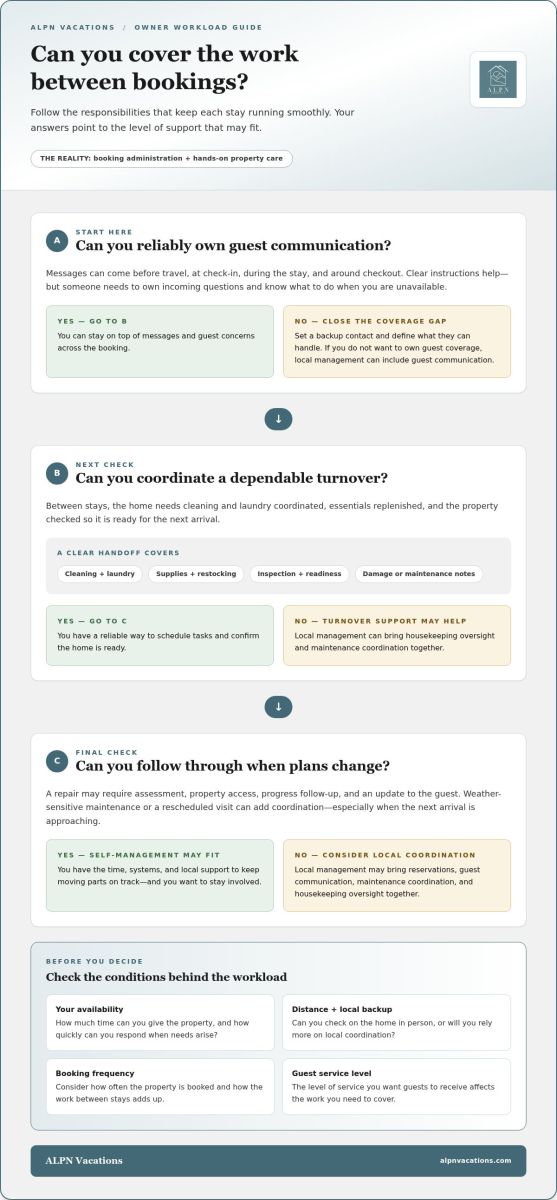
A useful decision starts with your actual workload, not an idealized version of it. Self-management may still fit if you have the time, systems, and support to meet your property’s needs. If responsibilities regularly compete with work or personal time, consider which tasks you want to keep and which you’d prefer to delegate.
The right management model depends on owner capacity, property needs, and desired involvement. Use this self-assessment to make the trade-offs clearer:
- 1. Availability: Can you reliably handle guest communication and property decisions alongside your other commitments? Consider what happens when you’re traveling, busy, or simply unavailable.
- 2. Property location: How easily can you reach the rental if an in-person check or coordination is needed? If you live farther away, identify who can help locally and what they can do.
- 3. Booking workload: Do the number and timing of reservations leave enough room for guest communication, turnover planning, and administrative tasks?
- 4. Backup coverage: Who can take responsibility if an unexpected issue comes up while you’re away or occupied? Name a person and clarify what they can handle.
Build a realistic picture of your workload
For a representative period, use your own records to log time spent on guest communication, listing upkeep, cleaning coordination, maintenance, and administration. Count interruptions and tasks handled outside your planned work hours, too. Separate predictable routines from occasional issues that call for prompt coordination. The aim isn’t to make every week look the same, but to see the pattern your records reveal.
Then sort responsibilities into three groups: tasks you enjoy, tasks you can reliably handle, and tasks you’d prefer to delegate. This helps distinguish the work that feels manageable from the work that consistently strains your time or attention.
Compare the full trade-off before changing course
Compare the time and responsibility you currently carry with the services and terms of the management arrangement you’re considering. Look closely at which duties would shift, which would remain yours, and how much control you want over guest communication and property decisions. Don’t rely on generic fee or income estimates; use your own workload records and the specific terms in front of you.
The problems with self-managing a vacation rental can be easier to assess once you can see the time, interruptions, and responsibilities together. If you’d like to explore a more supported approach in Ouray, learn about ALPN Vacations’ management services, including marketing, reservations, guest communication, maintenance coordination, and housekeeping oversight.
Local Vacation-Rental Support in Ouray: A More Hands-On Option
After weighing the workload, some owners decide they’d like help with day-to-day operations while staying connected to their property. ALPN Vacations is a locally owned and operated vacation-rental management company based in Ouray, Colorado. Its services address several responsibilities that can make self-management demanding: marketing, reservations, guest communication, maintenance coordination, and housekeeping oversight.
What local, full-service support can take off an owner’s plate
Reservation and guest-communication support shifts the work of managing booking details and guest questions from the owner to a management team. Marketing helps present the rental to prospective guests. On the property-care side, maintenance coordination and housekeeping oversight address the organization behind repairs and turnovers. These services support the operation of a rental without requiring the owner to give up every decision or connection to the property.
The practical value is in bringing related responsibilities together. Instead of personally tracking each reservation, coordinating housekeeping, and following up on a maintenance concern, an owner can decide which tasks to delegate and which to remain involved in. Local coordination in Ouray can be especially relevant to owners who aren’t nearby. The right arrangement depends on the property and the owner’s needs.
Keep a considered connection to the property
Choosing management doesn’t have to mean stepping away from what makes the home meaningful to you. Owners can decide how involved they want to be in property decisions while delegating operational work that no longer fits their time or availability. The aim is a well-cared-for rental and a welcoming stay for guests, supported by a level of owner involvement that feels sustainable.
The problems with self-managing a vacation rental can be a prompt to reconsider how the work is shared, not a sign that there’s only one right way to own a rental. ALPN Vacations brings local knowledge and defined operational support to homes in Ouray and nearby Southwest Colorado communities. For more detail on management in the area, read the Ouray management guide.
If you’re ready to explore support for your property, Explore ALPN Vacations.
Choose the Level of Support That Fits Your Ownership Goals
The problems with self-managing a vacation rental often come down to more than booking tasks. Guest communication, turnovers, and property care all take time and follow-through, while software can organize work without handling the hands-on needs of a home. Tracking your actual workload and considering your availability, backup plan, and preferred level of involvement can help clarify whether self-management still fits.
There’s no single right approach. You might keep managing the rental yourself, use tools to structure the routine, or delegate selected responsibilities. For owners who want local support, ALPN Vacations is a locally owned and operated vacation-rental management company based in Ouray. Its services include marketing, reservations, guest communication, maintenance coordination, and housekeeping oversight.
Explore ALPN Vacations and local owner support to learn about an option for sharing the work while staying connected to your property. With a clearer view of your needs, you can choose a path that supports both thoughtful ownership and a welcoming guest experience.
Frequently Asked Questions
What are the biggest problems with self-managing a vacation rental?
The biggest problems with self-managing a vacation rental are the ongoing demands on your time and the need to coordinate guest service and property care. You may handle inquiries, booking changes, arrival instructions, cleaning schedules, supplies, inspections, and maintenance follow-up. These tasks can overlap, and an unexpected issue may need attention during a guest’s stay. The workload depends on your property, booking activity, availability, and the service experience you want to provide.
Is self-managing a vacation rental worth it?
Self-management can be worthwhile if you value direct control and have the time, organization, and support to handle recurring responsibilities. Consider more than the management fee you might avoid: include the hours spent on guest communication, turnovers, maintenance coordination, and administration. Your own records can show whether the work feels manageable and whether the time trade-off suits your priorities. There isn’t one answer that fits every owner or property.
How much time does it take to manage a vacation rental yourself?
The time required varies with booking volume, property location, guest needs, and how much work you handle personally. Rather than relying on a general estimate, track time across a representative period. Include listing updates, messages, reservation administration, cleaning coordination, inspections, and maintenance follow-up. Count interruptions and tasks handled outside planned work hours, too. Your records will give you a more useful picture of the workload than a single average could.
Can vacation-rental software solve the problems of self-management?
Software can help organize calendars, reservations, messages, and recurring workflows, but it can’t perform every part of property care. Someone still needs to coordinate cleaning, check the home’s readiness, follow up on maintenance, and make decisions when a situation falls outside a routine process. Tools may reduce administrative friction, but owners should identify which physical tasks and guest needs still require personal attention or hands-on support.
What happens if a guest has a problem while I am unavailable?
If you’re unavailable, a guest may have to wait unless you’ve set up a clear backup plan. Decide in advance who can receive the concern, what they’re authorized to handle, and how they’ll keep you informed. For an Ouray rental, consider whether that person can coordinate any needed in-person property care. A defined point of contact and process can help prevent confusion when you can’t respond yourself.
Is hiring a vacation-rental manager better than self-managing?
Hiring a manager can be a better fit if you want to delegate recurring operational responsibilities, but it isn’t automatically the right choice for every owner. Compare the service scope and terms with the work you currently do, the time you want to reclaim, and the control you prefer to retain. ALPN Vacations is locally owned and operated in Ouray, with management services that include marketing, reservations, guest communication, maintenance coordination, and housekeeping oversight.
What should I consider when managing a vacation rental in Ouray?
For an Ouray rental, consider how you’ll handle guest communication, turnovers, maintenance coordination, and property access when you can’t be there yourself. Also understand the local requirements that apply to your property, since rules can differ between the City of Ouray and unincorporated Ouray County. Check current information from the relevant local authorities rather than assuming requirements are the same everywhere. Your location, availability, booking workload, and backup coverage all shape a workable plan.